How advanced ceramic materials and DLP-based 3D printing open new possibilities for aerospace and high-temperature applications

In space exploration, every component must perform under exceptional constraints: high temperatures, dimensional stability, miniaturization, material reliability, and long-term resistance in demanding environments.

A remarkable example comes from NASA’s Curiosity rover, where an additively manufactured alumina ceramic heater unit contributes to the operation of the SAM — Sample Analysis at Mars instrument. This case highlights the unique potential of ceramic 3D printing for applications where conventional manufacturing reaches its limits.

Today, this same potential is at the core of Prodways’ ceramic 3D printing solutions, combining high-precision DLP technology, advanced ceramic materials, and industrial process expertise.

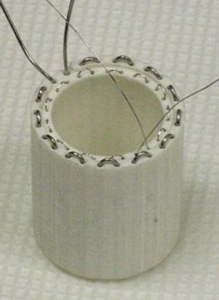
A ceramic component designed for Mars

A white, cylindrical 3D-printed part with a metal wire coil threaded through small holes along the top rim, shown against a textured white background in "csl_nasa_rover_heater_lo-res_prodways_printers.jpegOn board NASA’s Curiosity rover, the SAM instrument acts as a compact analytical laboratory. It studies Martian soil and rock samples to better understand the planet’s chemistry and assess whether Mars may once have had conditions suitable for microbial life.

Within this instrument, a small alumina ceramic heater unit plays a key role in heating samples for analysis. The component features complex internal geometries and supports multiple heating elements, while operating under severe thermal and dimensional constraints.

Why alumina ceramics?

This type of application demonstrates why advanced ceramics are so valuable in aerospace and space environments. Alumina, in particular, offers a strong combination of thermal resistance, electrical insulation, mechanical stability and chemical durability.

Why ceramic 3D printing makes the difference

Traditional ceramic manufacturing methods can become limiting when parts require complex internal channels, thin walls, fine details or highly integrated functions.

Ceramic stereolithography opens new design possibilities by enabling engineers to produce complex geometries directly from digital files, without the need for conventional tooling. After printing, the part is cleaned, debound and sintered to achieve its final ceramic properties.

Key advantages

For demanding applications such as heater components, insulators, analytical instruments, semiconductor equipment, aerospace systems or high-temperature tooling, this ability to combine geometric freedom with ceramic performance is a major advantage. 

From space exploration to industrial applications

While space exploration represents one of the most demanding use cases, the same technical challenges are found across many industrial sectors.

Ceramic 3D printing is particularly relevant when manufacturers need :

Eight industrial performance icons for additive manufacturing, featuring thermal and electrical resistance, dimensional control, design freedom, lightweight solutions, faster development, production versatility, and manufacturing flexibility.

Prodways ceramic 3D printing solutions

Prodways supports these high-performance applications with its CERAM PRO range of ceramic 3D printers, powered by the patented MOVINGLight® technology.

This DLP-based technology is designed to deliver high precision, repeatability and productivity for advanced ceramic applications. Combined with ceramic materials such as alumina and silica-based resins developed with Tethon 3D, Prodways enables manufacturers to explore new ways of designing and producing technical ceramic parts.

CERAM PRO 365

The CERAM PRO 365 is compatible with ceramic resins including ALUMINA A100/A110 and SILICA SICAST 1200, offering an industrial platform for applications requiring fine details, complex shapes and advanced ceramic performance.

What this application shows

The alumina heater unit used in the Curiosity rover illustrates a broader industrial reality: ceramic 3D printing is not only a prototyping technology. It is a powerful manufacturing approach for components that are too complex, too small or too functionally integrated for traditional ceramic processes.

This is exactly where Prodways’ ceramic ecosystem brings value: helping engineers transform complex designs into functional ceramic parts through the right combination of machine, material and process expertise.

From Mars exploration to advanced industrial production

Ceramic 3D printing is opening new possibilities for high-performance components. With its CERAM PRO solutions, advanced ceramic materials and industrial know-how, Prodways helps manufacturers develop complex alumina and technical ceramic parts for demanding applications in aerospace, electronics, energy, research and beyond.

Looking to develop a complex ceramic part?

Contact Prodways to explore how ceramic 3D printing can support your next application.

CONTACT US