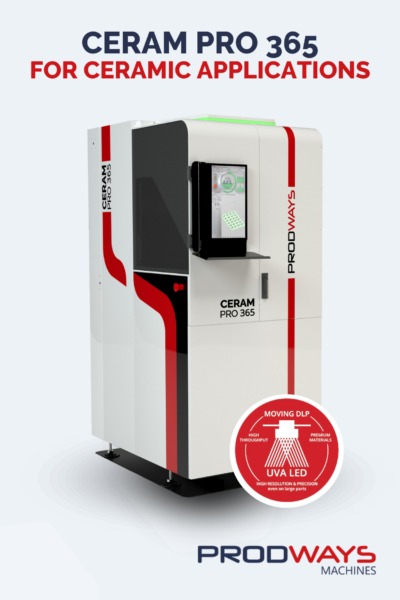
Ceramic additive manufacturing is entering a new phase of industrial maturity, and Prodways is one of the companies shaping this evolution. With the rise of complex turbine components, advanced semiconductor systems, and high-temperature aerospace parts, manufacturers are increasingly turning to 3D printing to achieve the design freedom and performance levels they need. At the center of this shift is the CERAM PRO 365, Prodways’ high-precision ceramic 3D printer powered by MOVINGLight® technology. To better understand how this technology is transforming production workflows, James Braddick, AMER Sales Manager at Prodways, shared his perspective on the challenges, innovations, and opportunities surrounding ceramic AM.
James, can you introduce yourself and your role in Ceramic AM?
James: “When I work with industrial clients, my priority is clear: help them leverage ceramic additive manufacturing to achieve precision and speed they simply can’t get with traditional methods. I guide manufacturers—particularly those in investment casting—through the transition from conventional ceramic forming to advanced photopolymerization-based AM. It’s not just about adopting a new machine; it’s about changing the way they think about design, timelines, and production capabilities.”
Some of our key collaborations are with major players like Honeywell, with whom we have carried out technical validation as part of specific development programs, and our goal is to help them integrate Ceramic AM safely and efficiently, ensuring repeatable results and clear ROI. These collaborations have demonstrated major benefits: cost savings in the range of several million dollars and a development cycle reduced from nearly two years to just 6–8 weeks.

 Customer Support
 Request Sample
 Contact