contact-button

Ceramic additive manufacturing is entering a new phase of industrial maturity, and Prodways is one of the companies shaping this evolution. With the rise of complex turbine components, advanced semiconductor systems, and high-temperature aerospace parts, manufacturers are increasingly turning to 3D printing to achieve the design freedom and performance levels they need. At the center of this shift is the CERAM PRO 365, Prodways’ high-precision ceramic 3D printer powered by MOVINGLight® technology. To better understand how this technology is transforming production workflows, James Braddick, AMER Sales Manager at Prodways, shared his perspective on the challenges, innovations, and opportunities surrounding ceramic AM.

James, can you introduce yourself and your role in Ceramic AM?

James: “When I work with industrial clients, my priority is clear: help them leverage ceramic additive manufacturing to achieve precision and speed they simply can’t get with traditional methods. I guide manufacturers—particularly those in investment casting—through the transition from conventional ceramic forming to advanced photopolymerization-based AM. It’s not just about adopting a new machine; it’s about changing the way they think about design, timelines, and production capabilities.”


Some of our key collaborations are with major players like Honeywell, with whom we have carried out technical validation as part of specific development programs, and our goal is to help them integrate Ceramic AM safely and efficiently, ensuring repeatable results and clear ROI. These collaborations have demonstrated major benefits: cost savings in the range of several million dollars and a development cycle reduced from nearly two years to just 6–8 weeks.
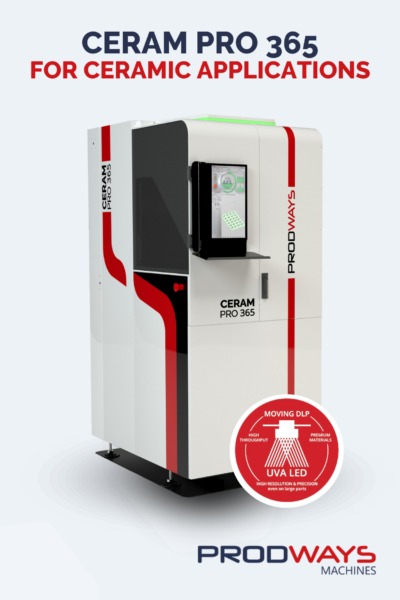
What makes the CERAM PRO 365 unique?

At the heart of this transformation is the CERAM PRO 365, a machine engineered for high-performance ceramics. James explains that its MOVINGLight® DLP technology maintains exceptional resolution and uniform energy distribution across a large build area, which is essential in ceramics where even micron-level variations can affect shrinkage, thermal performance, or dimensional accuracy after sintering.

The CERAM PRO 365 delivers 31-micron pixel resolution, enabling extremely fine features and sharp edges. Its build platform is modular, ranging from 66 × 41 mm up to 264 × 328 mm, with a maximum build height of 350 mm, supporting both R&D-scale prototypes and larger industrial components.

The 365 printer is compatible with Tethon 3D materials — including SILICA SICAST 1200 and ALUMINA A100 — which have been technically validated for use on Prodways machines through joint development work between Prodways and Tethon 3D.

“The strength of the CERAM PRO 365 lies in its repeatability,” James emphasizes. “Customers who print intricate cores or delicate features are often surprised by how reliably the machine holds tolerances from part to part. That’s where the value really shows up.”

Which industries are adopting Ceramic AM?

Demand for ceramic AM is strongest in investment casting, aerospace, and semiconductors. Investment casting requires sophisticated internal cooling passages, aerospace components demand high thermal resistance and precise dimensional control, and semiconductor manufacturers need components that combine precision with chemical inertness. Honeywell has leveraged ceramic AM to prototype and test components under extreme conditions, demonstrating confidence in the technology.

What challenges do customers face before moving to Ceramic AM?

Transitioning from traditional ceramic manufacturing to additive processes is transformative. Challenges include material qualification to meet strict specifications, adapting workflows from wax or shell methods to digital layer printing, evaluating ROI beyond equipment costs, and acquiring new design skills suited for additive manufacturing. Prodways supports each of these steps with tailored training, material development expertise, and close collaboration with engineering teams.

How is 3D printing changing ceramic component design and manufacturing?

“One of the most compelling advantages of Ceramic AM,” James explains, “is the freedom it gives engineers to design parts that were previously impossible or uneconomical to manufacture. Internal cooling channels, monolithic structures, and refined organic geometries are just a few examples. When engineers realize they’re no longer limited by mold parting lines or tooling constraints, they start designing more efficient, higher-performing components.” This approach also compresses lead times: iterations and prototyping that once took weeks can now occur in days.

Can you share a customer success story?

James: “One example comes from Honeywell. They needed a series of extremely small, high-precision ceramic components for test assemblies. Before adopting Ceramic AM, these parts were produced through manual machining, which was costly and constrained by tooling. With the CERAM PRO 365, they now print the same components at 31-micron resolution with layer thicknesses as low as 50 microns, achieving superior surface quality and greater design freedom. The modular platform also allows multiple parts to be printed simultaneously, significantly reducing lead times. Honeywell noted that ceramic is no longer a ‘special material’ reserved for exceptions; it has become a standard option in their prototyping workflow.”

How does Prodways help customers master Ceramic AM?

Supporting customers through these transitions is central to Prodways’ value proposition. James and his team provide hands-on machine training, guidance on design for additive manufacturing, material development assistance, and ongoing engineering optimization. 

“We stay involved well beyond installation because stable, repeatable industrial production requires ongoing collaboration.”

What’s the next big innovation in Ceramic AM?

Looking ahead, Prodways sees several developments shaping the future. Automation in post-processing will streamline debinding, sintering, and finishing. AI-driven design tools will accelerate optimization and predictive performance analysis. New materials, including polymer-derived ceramics, will open the door to even more demanding applications. Through advancements in MOVINGLight® technology and a long-term commitment to ceramic innovation, Prodways aims to provide industrial customers with the performance, scalability, and reliability required for the next generation of technical ceramics.